
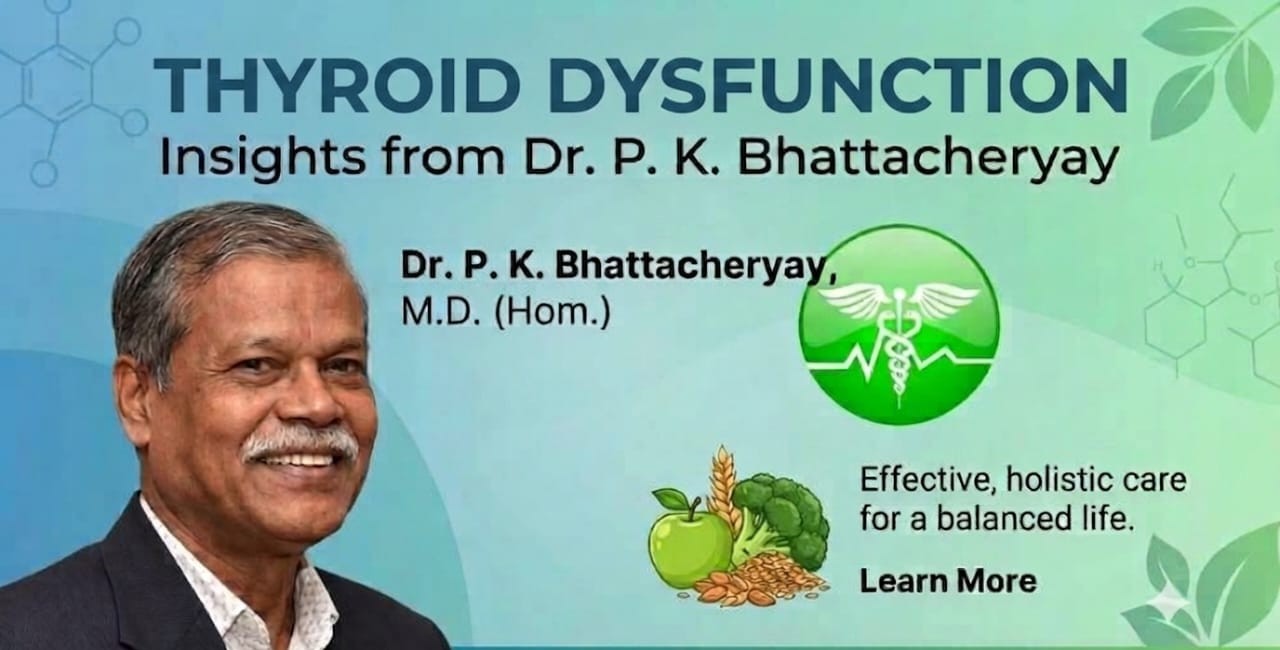
Thyroid Dysfunction: An Overview & Its Homoeopathic Management
Thyroid disorders occur when the thyroid gland makes too much or too little hormone, throwing off the body's energy use, weight, and heart rate. The two main types are an underactive thyroid (hypothyroidism) and an overactive thyroid (hyperthyroidism) — both of which can be supported through individualised homoeopathic care.
What Are Thyroid Hormones?
The two most important thyroid hormones are thyroxine (T4) and triiodothyronine (T3), which account for roughly 99% and 1% of thyroid hormone present in the blood respectively — though T3 is the one with the most biological activity. Once released into the blood, a large amount of T4 is converted into T3, the active hormone that drives cellular metabolism.
Production of these hormones is directly controlled by the pituitary gland, an endocrine gland at the base of the brain that secretes TSH (Thyroid Stimulating Hormone). When T3 and T4 fall below the required level, the pituitary raises TSH to stimulate more production; as T3 and T4 rise, TSH output falls again. Because thyroid hormones govern the speed of the body's chemical reactions and influence mental and physical growth, any excess or deficiency has widespread consequences.
The Hypothyroidism Burden
Deficiency of thyroxine is called hypothyroidism, and it can affect any age group though it is most prevalent in older women. It is broadly classified into two types: primary hypothyroidism, where the problem lies in the thyroid gland itself, and secondary hypothyroidism, where the pituitary gland fails to produce sufficient TSH — which in turn reduces T3 and T4 output from an otherwise capable thyroid.
Causes of Underactive Thyroid
Iodine Deficiency
A common cause in certain geographic areas where dietary iodine is low.
Hashimoto's Thyroiditis
Auto-immune inflammation where the patient's own immune system damages the gland.
Post-Thyroidectomy
Surgical removal of the gland or a nodule can lead to hypothyroidism years later.
Post-Radiotherapy
Radioactive iodine given for hyperthyroidism can destroy too many hormone-producing cells.
Pituitary Failure
Tumours or inflammatory/foreign infiltration of the pituitary reduce TSH secretion.
Hypothalamic Dysfunction
A less common secondary cause affecting the signal chain above the pituitary.
Risk factors for secondary hypothyroidism include being over 50 years old, being female, and having a history of pituitary or hypothalamic dysfunction.
Diagnosis of Hypothyroidism
Diagnosis is established by measuring T4 and TSH levels in the blood. Since hypothyroidism means a deficiency of thyroid hormone, T4 (and T3) levels are below normal. In primary hypothyroidism, TSH is high because the pituitary is trying to push a sluggish thyroid to produce more hormone. In secondary hypothyroidism, the pituitary itself is under-functioning, so TSH, T4, and T3 are all below normal.
| Hormone | Normal Levels |
|---|---|
| T3 (Triiodothyronine) | 80–180 ng/dl |
| T4 (Thyroxine) | 4.6–12 µg/dl |
| TSH (Thyroid Stimulating Hormone) | 0.5–6 µU/ml |
The Homoeopathic Approach
Homoeopathy considers thyroid dysfunction to be, in many cases, an autoimmune glandular imbalance connected to emotional distress and frustration. Rather than simply supplying deficient hormone from outside, homoeopathic treatment aims to stimulate the thyroid gland itself — encouraging the body to reactivate its own hormone secretions and restore thyroid tissue through the pituitary and other glands as a whole.
Homoeopathic remedies are non-habit forming, have no addictive characteristics, and can generally be taken safely alongside other medications. Treatment may be useful as a supportive therapy for regulating both "hyper" and "hypo" conditions of the thyroid.
Duration of Treatment
The total length of treatment varies from case to case, depending on several factors:
- 01 Duration of underactive thyroid — best results are seen in cases of up to three years' duration
- 02 Extent of dysfunction — the levels of TSH, T3, and T4 hormones at the start of treatment
- 03 Concurrent thyroid supplement — patients on supplements for more than 2 years tend to respond less well
- 04 Age of the patient — those below 45 generally respond better
- 05 Results are typically observed within four to six months, as TSH levels begin to reduce
Why Homoeopathy for Underactive Thyroid?
Fundamentally, homoeopathic treatment aims at stimulating the thyroid gland to produce its own hormones rather than treating an external supply as the cure. The goal is to correct the internal imbalance — and where achieved successfully, a lifelong need for thyroid supplement may not be required. Even patients already on thyroid supplement for about two years can explore the possibility of tapering it under guidance, using homoeopathy alongside their existing treatment.