
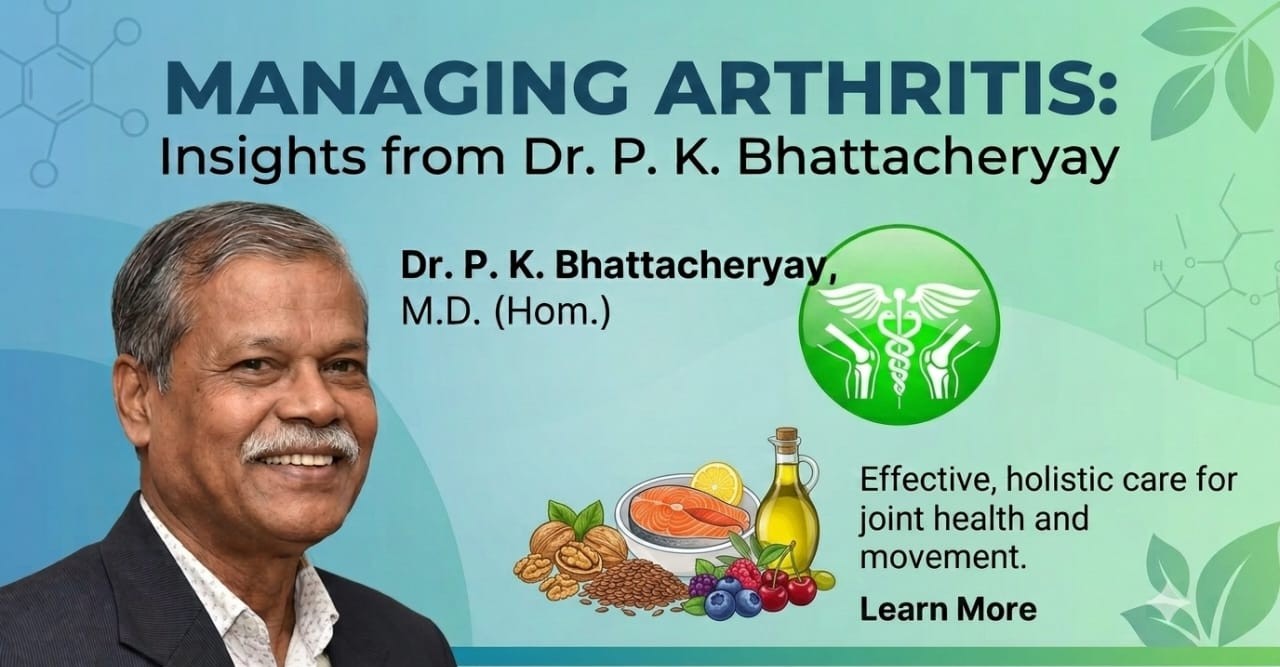
Homoeopathy & Bone-Joint Diseases: A Comprehensive Overview
Arthritis — whether osteoarthritis, rheumatoid arthritis, ankylosing spondylitis, or gout — affects millions worldwide. While conventional medicine offers symptomatic relief, it often falls short of addressing the root cause. Homoeopathy presents a holistic alternative that treats the individual as a whole, aiming to reduce pain, improve joint function, and enhance quality of life.
Understanding Osteoarthritis
The exact cause of OA is often multifactorial, but the primary pathological changes are well recognised. Early symptoms are typically mild but progress over time, eventually limiting movement and daily function.
Pathology
Cartilage Degradation
The smooth, elastic cartilage wears away, exposing the underlying bone.
Osteophyte Formation
Bone spurs develop at the joint margins.
Synovial Inflammation
The joint lining becomes inflamed, leading to swelling and pain.
Signs & Symptoms
The Homoeopathic Approach
Homoeopathy views osteoarthritis as a disturbance in the body's vital force, aiming to stimulate self-healing. It focuses on treating the individual as a whole rather than just the symptoms — considering physical, emotional, and lifestyle factors together.
Rheumatoid Arthritis
Rheumatoid arthritis (RA) is an autoimmune disease that causes chronic inflammation of the joints. It can also affect surrounding tissues — muscles, tendons, ligaments — as well as other organs such as skin, blood vessels, heart, and lungs. RA is a chronic, progressive condition, with periods of activity ("flare-ups") interspersed with symptom-free periods ("remissions"), and over time it can cause joint destruction and functional disability.
Scientists believe a genetic tendency underlies RA, with certain infections or environmental factors possibly triggering the autoimmune response. Stress can act as both a predisposing factor and a trigger for acute episodes. The disease is three times more common in women, affects all races equally, and most often begins between the ages of 40 and 60.
Common Symptoms During Flare-Ups
- 01 Joint swelling, redness, tenderness, and stiffness with limited range of motion
- 02 Muscular pains, and hand/foot deformities at later stages
- 03 Fever and loss of appetite
- 04 Multiple joints affected symmetrically — commonly small joints of the hands and feet, elbows, and ankles
- 05 Skin redness or inflammation, and round, painless nodules under the skin
- 06 Inflammation of the lung (pleurisy) and swollen glands
- 07 Anemia
Diagnosis
Gout
Gout is a form of arthritis caused by excessive uric acid production, resulting in urate crystals depositing in joints — particularly in the extremities, such as the toes. Urate levels may rise from consuming purine-rich foods or from underlying factors affecting urate clearance from the blood. Treatment typically involves managing pain during acute attacks and reducing uric acid levels to prevent future episodes.
Homoeopathic treatment is highly individualised — the selection of remedies depends on the specific symptoms and constitution of each person. A qualified homoeopath conducts a thorough evaluation and selects the most appropriate remedy for each unique case. Early and timely initiation of treatment for any joint disease helps achieve better disease control, symptom relief, and improved mobility.
Chances of Recovery Depend On
- 01 Duration of disease — the higher the duration, the more difficult the outcome; earlier treatment gives a much higher chance of cure
- 02 Control of disease — well-controlled and partially controlled cases are more hopeful than uncontrolled cases despite high dosages
- 03 Family history — cases with multiple affected family members are more difficult
- 04 HLA-B27 positive cases are more difficult than sero-negative ones
- 05 Patients on long-term steroids or biologicals are more difficult to cure
- 06 Patients with severe deformities may not be cured, but can expect better disease control and improved mobility
- 07 Patients with co-morbidities like heart disease, cancer, or psoriasis are very difficult
Our Homoeopathic Treatment Approach
At our clinic, every patient receives a personalised consultation. Treatment begins with a detailed evaluation of the patient's condition, disease stage, lifestyle factors, and medical history — with the objective of clearly defining diagnosis and prognosis, and building an individualised plan of care tailored to each case of osteoarthritis, rheumatoid arthritis, or gout.